Showing posts with label dogs. Show all posts

Monday, September 6, 2010

"Cuter Than Republicans"


I don't want to get anybody into trouble by naming names, but a Loyal Reader surreptitiously took this photo at the "First Pets" exhibit at the Bob Bullock Museum and provided the topic for our blog. Pictured above is a display is of the First Dog of Texas's dog house, a replication of the Governor's Mansion. Here's what the display text says:

"The Mansion-themed doghouse became a popular attraction during Christmas candlelight tours hosted by Governor Rick Perry and First Lady Anita Perry (2000-). In 2004, the family incorporated images of Lucy, their Miniature Dachshund, in several holiday decorations throughout the house. Lucy actually did not sleep in the canine Mansion but stayed with the family in the private quarters."

My comment to Loyal Reader was that I had no use for certain Republican governors but that Lucy was in all ways cute. To which LR replied, "Dogs are always cuter than Republicans." Who am I to contradict? Thank you, LR, for the photos and for making me laugh. -z

Wednesday, September 1, 2010

File Under "Double-Take"

Hi, all. Fellow Parker and blogger Michelle (Mindy) sent along a link to her friend Tony Chor's blog. Tony posted this picture. What do you think?


I saw it and thought, "There's something definitely wrong with that panda." Those of you who have had your coffee have probably already figured it out. That's no panda; it's a dog. Hunh. I had a similar reaction the day I looked out my window to see a neighbor walking the ugliest dog on the planet. Oops. It wasn't a dog; it was a pot-bellied pig.

At Dog Park, we have plenty of dogs named Bear (or variations, like Oso), but none actually looks like it could climb a tree or bust into your car (or your cranium) with razor sharp talons. The "panda" pictured here is eerily like the real thing. Plus, it really lives in China. To read Tony's entry and find a link to a CNN  story about China' new craze of dyeing dogs to look like wild animals (and even Ninja turtles), click here. Thank you, Michelle! Thanks, Tony!
-z

Sunday, April 4, 2010

Bluebonnet Photos of the Day


Franklin and Mindy, the dashing duo is back in action, sans capes.


Mindy and Muzzy

Once again, photos and Frankie, courtesy of Diane, available for viewing and downloading at dogparkaustintx@shutterfly.com
Mindy, courtesy of Michelle, bloggeuse extraordinaire, @ fortyisthenewfood.blogspot.com
-z

Saturday, April 3, 2010

Typecasting

This particular bit of dog-and-publishing whimsy had been circulating around the Web. I found it here, but one can follow the links back through several sites. As an editor who squints up at her new, enormous computer screen and still can't distinguish Times New Roman from Cambria and Palatino fonts, I like the association with dogs. I'd prefer to send out documents in Rottweiler or Daschie. Alas, there is no Mutt font, which is the one I'm sure I'd like best.

Enjoy. -z

Friday, April 2, 2010

The Secret Life of Emily Dickinson's Dog

I am reading a fascinating novel about the life of American poet Emily Dickinson. Long viewed as an eccentric, reclusive spinster, the Belle of Amherst seems unlikely material for a novel. In novels, as I tell my tutees and student readers, things are supposed to happen—characters face and resolve conflicts, they grow or they don't, readers learn something about life and the human condition. What kind of story can a modern novelist spin about a woman who rarely left her house, never married or had children, and left little personal affects besides a trunk full of enigmatic scribbles? The answer is plenty. The Dickinson in Jerome Charyn's latest work, The Secret Life of Emily Dickinson (W.W. Norton, 2010), is icy, sharp-tongued, smart, spoiled, ignored, eccentric, wildly imaginative, passionate, red-haired, and a little bit nuts.

Of course ED gets tarted up for a modern novel. (Take a look at that atrocious cover, will you?) But the unexpected part? Emily Dickinson has a dog, a giant Newfoundland named Carlo. He is Dickinson's chaperone for fifteen years, accompanying her on poetry-spinning strolls through New England apple orchards and illicit adventures to rum-houses where she meets and falls in love with inappropriate and not-quite-sane men. Carlo is protector and companion, and he grows to be both enormous and ancient. Hot tears I wept as I read of a half-blind Dickinson returning from a trip to Boston, entering her father's house, and crying, "Where's my dog?" Because, of course, the end is near. Carlo goes to sleep for the last time in a soft bed beside his mistress' own, during a snow storm that whitens the world:

. . . My fellah had died in his sleep, sitting on his blanket a foot from my bed.
I lay down beside Carlo in his bassinet. I must have been there five or six hours, my arm around his neck, and would have stayed another six if Pa-pa hadn't started tugging at me. He would tell people how I had all the strength of a steam engine, and that he couldn't pull me loose until I heard Ma-ma cry.
"Em," she moaned, "you cannot stay in this room forever with a dead dog."
I would have stayed, but I couldn't bear that look of horror in Ma-ma's eye.

And by the next chapter, Dickinson has assumed the persona that every American high-school student knows—the recluse clad in white who refuses to leave her house. Spoiler alert: The reason for her donning virginal colors is not a heart broken by a man or a youth lost. No, indeed. She is mourning her dog.

I wandered from room to room like the ghost that everyone thinks I've become, dressed in all white, because I will wear no other color while Carlo's soul is in Purgatory—I for one am not convinced there is much of a Heaven for dogs; they are doomed to wander somewhere, and while my Carlo was wandering, I will wear only white.

Mystery solved. Her reaction makes perfect sense.

The book is available at Austin Public Library.
-z

Thursday, February 4, 2010

The Literary Dog: A Gothic Tail

A recent New Yorker article profiled the British writer Neil Gaiman, who specializes in creepy gothic tales and graphic novels for tweens of all ages. The article made a big deal of his children's book Coraline (Harper Trophy, 2002), which, a friend told me, has a pretty high creep-out factor. So I thought it would make for good reading on a cold, dreary, rainy night.  The story goes like this: a girl, an only child of unengaged parents, moves to an old house in an English country town. The parlor contains a locked door that opens onto a brick wall. Naturally,  the doorway is magical, and Coraline wanders through it to an alternate universe, where her "other" parents and neighbors live. They are exactly the same as her real parents and neighbors, except that they have buttons for eyes. The "other" mother appears at first to be far more nurturing and imaginative (and a better cook) than Coraline's real mum, and the girl is tempted to stay in the alternate world, but she decides not to. In revenge, the other mother kidnaps Coraline's real parents, and Coraline's challenge is to rescue them and escape from eternal bondage. Sheesh. The stakes are high.

There are dogs in the book, but it is the cat who helps save the day. It, like Coraline, is able to travel between the two worlds—although it can only talk in one of them, thank goodness. The dogs, as you might expect in a book in which a cat is the hero, come off as rather dumb and easily entertained. Here is a bit from a scene in the alternate world. Coraline has found her way to an old theater run by her "other" neighbors, Miss Spink and Miss Forcible. She is ushered to her seat by a gruff Scottie dog with a flashlight in his mouth. All the other theater-goers, it turns out, are dogs who express their appreciation of events onstage (Coraline has just participated in a knife-throwing demonstration) by thwacking their tails against the velvet seats.

    Miss Spink gave Coraline a very small box of chocolates and thanked her for being such a good sport. Coraline went back to her seat. 
    "You were very good," said the little dog. 
    "Thank you," said Coraline.
    Miss Forcible and Miss Spink began juggling with huge wooden clubs. Coraline opened the box of chocolates. The dog looked at them longingly.
    "Would you like one?" she asked the little dog.
    "Yes, please," whispered the dog. "Only not the toffee ones. They make me drool."
    "I thought chocolates weren't very good for dogs," she said, remembering something Miss Forcible had told her.
   "Maybe where you come from," whispered the little dog. "Here, that's all we eat."
    Coraline couldn't see what the chocolates were, in the dark. She took an experimental bite of one which turned out to be coconut. She gave it to the dog.
    "Thank you," said the dog. 
    "You're welcome," said Coraline. 
     —from Coraline, pp. 42-43


Of course, dogs may only eat chocolate and say "thank you" in an alternate reality, but they do get to sit on the furniture wherever they are in the space-time continuum.

Enjoy!
-z

Wednesday, January 20, 2010

Hang Up and Catch the Ball!


This article in last Sunday's New York Times discussed the rise in self-inflicted injuries caused by people who walk while talking on the phone. They fall off curbs, walk in front of oncoming cars, collide with parked cars, telephone poles, or street signs—often seriously enough to require medical care. The number of incidents ending in visits to the emergency room doubled in one year, according to the article. The reporter, Matt Richtel, explains: "Sometimes, pedestrians using their phones do not notice objects or people right in front of them—even a clown riding a unicycle." He then tells about a recent study that tested people's awareness of a clown riding a unicycle down the street. Half the people walking without phones noticed it. Only a quarter of those on phones did.

The part that interested me, though, was a comment by a California neuroscientist about the effect of use of phones on the human brain. Phones allow us to "pursue goals that feel more important than walking down the street." The article continues with the doctor's next point: "'An animal would never walk into a pole," he said, noting survival instincts would trump other priorities."

The dog owners I talked to about this rolled their eyes. Perhaps a wolf or a lion or an elephant is focused enough on its objectives—i.e., walking and surviving—to avoid colliding with trees or street signs. But most dogs I know have had many blooper reel moments while chasing a fast moving object instead of watching where they were going. My Muzzy routinely ends up clattering over or into the dog bowl in our back yard while chasing one of my poorly executed throws. Or she ends up in the rosemary bush, which, like Charlie Brown's kite-eating tree, seems to suck the ball out of the air no matter how carefully I aim it. I'm sure that if the writer of the NYT article had called local veterinary clinics, he would have discovered some significant statistics of doggie collisions while ball-chasing. So, which is more important? The spectacular catch or eyes on the road? I think how you answer that question will say a lot about your dog's personality—and your own.

Ta. -z

Friday, January 15, 2010

Always a Cross Word


As an underemployed person, the challenge every day is to fill up the hours in a meaningful and satisfying way. I always start out the week with a burst of activity. This week, for example, I filed all my office papers and reorganized by client files. (So easy! Half are out of business. Those papers get filed in the shredder.) I also cleaned the bathroom, made a pot of soup, baked bread, and cleaned out a closet. Then I borrowed Erica's power drill and installed a new screen on my carport door and reinforced my sagging privacy fence. In addition, I walked with Muzzy to the library twice. That was just Monday and Tuesday.

By Thursday, things slow down. I look up at the clock and realize that it's only noon, and I wonder how the heck to fill in the hours until I can walk a dog. (Muzzy says, "It's always time to walk the dog!" Nice try, Muzz.) That's where crossword puzzles come in. I'm not very good at them, as you can see. I have a book of NY Times x-words called something like Cafe Crosswords, which is a polite way of saying crosswords for the lame. (The lamest part is that these puzzles were originally published in the paper in 2003-2004, which means that I have already done most of them before.) I can kill hours working on these things, and lately I have, especially at night. I have no wisdom to impart or tricks that I have learned—except to be patient and let the words form themselves. Each new puzzle is, for me, like starting at the foot of Mount Everest and hiking to the peak. But here are a few clues—and answers—that involve a favorite topic: dogs.

Clue: "Treat for Rover" (4 letters): bone

Clue: "Nick and Nora's dog" (4 letters) : Asta

Clue: "Ark or bark" (4 letters): boat (That one took me a while.)

Clue: "Friend of Fido" (3 letters): Rex

Clue:  "Garfield's pal" (4 letters): Odie (Not to be confused with "Andy Taylor's son": Opie)

Clue: "Dogfaces" (3 letters): GIs

Clue:  "Onetime White House pooch" (4 letters): Fala

Clue:  "Terrier type" (4 letters): Skye

Clue: "Genetic engineer's observation about his pet?" (14 letters): My dog has fleece
(This puzzle featured phrases in which the last word ended in the -eese sound.)

Clue: "Dog-paddled" (4 letters): swam
-z

Friday, January 8, 2010

Animal Spirits


I'd heard of mineral spirits, of course. I remember using them in high school art class to clean paint brushes. But animal spirits was a new one. I came across the term in a blog on The New York Times Web site, Schott's Vocabulary. In it, Ben Schott considers an interesting new or obscure word or term every day. Thursday's was animal spirits. According to Schott and other sources, animal spirits is a term coined by the economist John Maynard Keynes in the 1930s to describe the irrational or instinctual confidence exhibited by people in the business world, particularly Wall Street types. The term came up this week because, at the start of this new year, financial writers were suggesting that animal spirits were making a resurgence. Schott cites the Economist, which says that Keynes defined animal spirits as "naive optimism"—a sort of confident cheerfulness, a state of mind in which the person ignores or forgets facts of life, such as death and taxes. The idea comes from the notion that animals can and do act from instinct and with exuberance because they are not aware of the possibility of their own deaths—or any consequences. In fact, "animal courage" was one of the original meanings of the term, per the Oxford English Dictionary. Another was simply "voluntary motion"—action caused by nerves and muscle.

The idea intrigued me, and, of course, my thoughts turned to the dogs. I have often wondered what they think, and I often put words to the thoughts I imagine ("I don't care if you wrap that stinking pill in cat poop; I am not going to swallow it." "Mailmanmailmanmailman!!!!"), but I never stopped to consider what they don't think about. Or how their lack of awareness of danger and illness and death frees them to burst into action. Any dog owner knows that desire or curiosity is all a dog needs to inspire naughty or silly or bad behavior. When a dog spots a squirrel, she doesn't look both ways before charging across the street. That's how animal spirits work. Somehow it does not inspire confidence—or animal spirits—in me to know that the people who invest our money rely on the same impulses as a dog that rolls in poop and then jumps on the bed.

I did please me to discover that Jane Austen used the term animal spirits in my favorite of her books, Pride and Prejudice (the version without zombies, thank you). I've read the book probably 30 times and never thought twice about the phrase, but it perfectly suits the character of Lydia Bennett. Here, Austen is describing Lydia, the youngest, silliest, most flirtatious, and least decorous  of her five sisters:
Lydia was a stout, well-grown girl of fifteen, with a fine complexion and good-humoured countenance; a favourite with her mother, whose affection had brought her into public at an early age. She had high animal spirits, and a sort of natural self-consequence, which the attentions of the officers, to whom her uncle's good dinners and her own easy manners recommended her, had increased into assurance.
The meaning Austen intends here is the one still recognized by the OED (which, by the way, does not recognize Keynes's definition)—"natural gaiety of disposition." But Lydia, as all readers of the book learn, illustrates Keynes's meaning, too. She displays naive optimism by not even pausing to think of her family or her reputation before running off with a handsome but penniless scoundrel. To Austen's credit, like any indulgent dog owner, she gives Lydia a pass. All ends well for Lydia and her sisters, just as all goes well for Muzzy when she steals another dog's ball or jumps in a mud puddle. All the responsible adults go "Tut, tut. For shame!" Then they tell her how cute she is and throw the ball again.

I recommend the following New Year's Resolution: To maintain animal spirits—within reason.
Ta! -z

Wednesday, December 23, 2009

The Dogged Aughties


I've already seen articles about what to call the first decade of the twenty-first century as it draws to a close, so I don't think a blog entry out of line here. Looking back, of course, I can't believe that it has been ten years since Y2K. Has there ever been such misplaced anxiety? Y2K seems like a school-kid prank in light of what was to follow--terrorist attacks, war, deadly hurricanes and flus, financial calamity, global warming, drought.

Let's review: Plague? Check. Before there was H1N1, there was Australian B. The sun had not set on the first day of 2000 when I succumbed to a wicked strain of that flu. I was stuck at my in-laws without my dog. I hacked my lungs out until Valentine's Day. Years later, I was stricken with a mysterious stomach ailment that laid me low for months. Sadly, I ate my last chile pepper and chocolate bar and sipped my last latte and my last gin and tonic in 2008.

Exile? Check. I spent the early part of the decade moving around the country in pursuit of my former husband's sputtering career opportunities. Then I was stranded in New England during a mortifying separation and divorce. Fortunately, I had the good sense to move back to Austin, where everyone is in exile from the rest of the state.

Loss? You betcha. Perhaps it happens to all good people who reach their middle ages, but I've clocked more time at funerals than at weddings this decade. I've lost elderly friends, a parent, and a godparent. I lost friendships, too, in the 2000s, for reasons I can't explain. Now my Roma is experiencing technical difficulties with her eating, walking, and sleeping. Her loss will truly signal the end of an era.

Impoverishment? Check, please! As a freelancer, I thought I understood the vagaries of the market, but I never in a million years expected the industry that has supported me for two decades to implode. In January, two of my most reliable clients went out of business without a word and still owing me and several fellow freelancers thousands of dollars. Since March, work has been scarce and payments sloooow. We now ration Nylabones at our house and use cheap soap and coupons.

So, looking back, I think I understand why it feels as though I've been taking it on the chin: I've been taking it on the chin--though no more than most people have. And yet . . . and yet, on the day-to-day, basis, things have not been so bad, have they? (Were they?) Some perspective: Every day for the past 3,650 days, I've had to get out of bed in the morning and take care of a dog or two. We leash up, walk around, chase a ball, eat some kibble, hang together in the  office when I work. Later, we load up in the car and head to Dog Park and pace out a couple of miles at least, no matter the weather. During  this decade, no matter how badly things were going or how miserable we felt, I stuffed my pockets with plastic bags and took the girls out, and somehow walking made us feel better.

So, my friends, I christen our nearly departed decade "The Dogged Aughties," in honor of ten years whose grief and pain were dulled only by walking our paws off or hurling a ball hundreds of times. Even in these worst of times, my dogs remind me that every day is full of possibilities and that even the smallest hope of a brand new Nylabone or a morsel of cheese in the food bowl is worth getting up for. Times will get easier, eventually, and then they will probably get hard again. That is, history books tell us, how they do. The dogs don't know that. Or perhaps they do; they just don't let a bad day—or a bad decade—get in their way.

Here is to a peaceful end to the 2000s. Happy and safe holidays to all.
-z

Tuesday, December 15, 2009

Walkabout with Dogs


Once again the New York Times confirms the obvious—that people who walk with dogs are more likely to be fit and to exercise consistently than those who walk with fellow homo sapiens. Are you surprised? I didn't think so.

In a recent entry on her regular blog, Well, Tara Pope-Parker explains how a study of 54 senior citizens living in Missouri were divided into three groups—those who walked with dogs, those who walked with human partners, and a control group (i.e., couch potatoes). The folks who took a bus to a local animal shelter to walk with a dog every day increased their walking speeds nearly 30 percent (compared to less than 5 percent in the walkers with human companions).  They also were eventually able to give up walking aids, such as canes or walkers. The reason? Dogs  never say no to a walk. On the other paw, human companions were constantly trying to talk each other out of taking a walk. The excuse? "It's too hot." We, the survivors of the hottest summer on record in Texas blow our noses in your direction, Missouri. Hahahahahaa! Weaklings!

Among the comments posted to the blog entry—and I paraphrase—"You don't have to pick up your human companion's crap, but you do have to listen to it." At Dog Park, we have the best of both worlds--walking with humans and with dogs. There's crap galore, so bring plenty of bags.

We hope to see you at the Dog Park. Bundle up, though. Wind chill will put the temps in the 30s. Brrr.
-z

Wednesday, November 25, 2009

The Dog Parkist: Family Ties That Bind


Q: The holidays are upon us, and I must go face my family. Don't get me wrong; I love my family, but I am the lone single person, and I have dogs instead of a spouse and children. I spend the whole time listening to parents, aunts, grandparents, cousins, and siblings discussing the joys and tribulations of poopy diapers, potty training, pre-school applications, day care costs, and runny noses. My family members who are parents of small children and I actually have a lot in common. I think young kids and dogs are similar in a lot of ways, but no one else sees the situation that way. They think my animals are a poor substitution for real offspring. They don't always say so, but I can read the thought bubbles above their heads. What can I do? --Mother of Dogs, Not Kids


A: First, my dear, let me congratulate you for taking the saner, greener, morally responsible way. As a dog owner without children, you have spared the local landfill a mountain of dirty diapers and broken Star Wars toys. You have chosen a quieter, more Zen-like path. You love silently and are loved unconditionally in return. You have saved a life from the streets and are rewarded every day with tail wags and sloppy kisses. What's more, you don't have to participate in the rat-race of school selection and the crap shoot of potentially rearing a pot-smoking ax murderer despite all of the Baby Genius CDs and Wii skill-development games you invested in. Dogs will never drink underage, take drugs, wreck the car, date unsavory boys. They will always forget your birthday, true. It seems a small price to pay. Amazon.com always remembers, as does your insurance company, especially after you hit 40, so who cares?

Now, to your family. Please allow me to remind you that few truly sentient and sensitive individuals actually believe that they were born into the correct family. Most of us look around at our derelict cousins, our over-indulged siblings, and our frazzled parental units and wonder, can these truly be my people? Well, my dear, they are, genetically speaking. But you have looked deep inside yourself and understood that your true people are the canines you live with. They are the ones that look sad when you've had a bad day and offer pink tummies as a solace. They are the ones that know when you are feeling puny with a cold or a migraine and pull a little less forcefully on the leash as a courtesy. They love you so much that they must stand in the same room to watch you pee. They adore you so much that they don't want you to sleep in and miss out on the squirrel races outside your window. Who in your family would do the same?

To be fair, unlike your family members, your dogs never have to worry about losing their jobs or their houses, going grocery shopping, or paying cable bills and car payments, so they can afford to be focused on you exclusively. So, do yourself a favor, my dear. Stop making comparisons. Indulge your family members on the holidays just as you would your dogs. Let them talk over you and down to you. Let them think they have got you all figured out—that you'd be happier if you lost weight or had an extra piece of pie; that you'd have found yourself a husband if you hadn't gone to graduate school; that you have no idea of the bliss borne of the pain of childbirth. They are entitled to their opinions. Just smile and think of your dogs. They are waiting for you at home, waiting so patiently for that little bit of turkey and stuffing you promised them. Ooh, and a smidge of mashed potatoes--with gravy, if it's not too much to ask. Also, pie would be nice. Thanks for writing!

Dear Readers: The Dog Parkist knows that the holidays are a stressful time for everyone, especially dog owners. So do please remember that the D-Pist is here for you. Send her your questions and concerns, and she will do her level best to set you straight. Ta!

Tuesday, November 24, 2009

Do You Smell Something?


Anecdotal evidence suggests that there has been an uptick in rolling at the Dog Park. Everywhere I look, there is a dog with its feet in the air, scootching its back and neck into something yucky. Even our Muzzy, who until recently cared only about stealing tennis balls from other dogs, now waits patiently for her turn to roll in a particularly popular spot (down near Crazy Guy's house, under the live oaks). Instead of pouncing on a dog she didn't know (another new and unfortunate behavior), she simply watched and waited. When the dog trotted off, she threw herself down to sop up any stink that might still be absorbed.

In a more fastidious household, all of this rolling might result in an uptick in baths. Alas, I can hardly remember to wash my own hair let alone two shaggy, bath-resistant dogs. Plus, I don't sleep with my dogs, so I can cut them some smell slack. Still, every day, I give them the sniff test. Muzzy always smells like nutmeg—it's a dark, spicy, actually rather pleasant scent. Roma, no matter what I do, always smells like an old sponge—even after baths, so why bother. Our friend Sarah says that she knows that it's time to give Tony-boy a bath when his head smells like enchiladas. Red or green?

I have a host of excuses for not washing the dogs. Our yard is a dust bowl when the weather is dry and a mud pit when it rains. What is the point of washing the dogs if they are going to lie down in dirt while they dry? I know that I could spend money and take them to a groomer or to a local do-it-yourself dog wash that folks have raved about, but, as you know, I'm from New Jersey. I don't pay money to wash my car or my dogs. I have a hose and a bucket and soap. I just need the incentive--a smell so overpowering I can't ignore it. Skunk. That's one I'll respond to. Please don't give my dogs any ideas.

The rose in the photo is my one shining gardening moment this year. Last spring, I transplanted one of my heirloom rose plants (a gift from a Dog Parker who moved to Seattle) from a spot where it was feeling puny to a sunnier location. By May, I realized that I had made a big mistake. I watered that poor plant two or three times a day with stale dog-bowl water in an effort to keep it alive through the hottest, driest summer in fifty years. In September, I was certain that the thing had died. Then, the other day, I noticed one crimson, velvety rosebud hanging from the plant. I snipped it off and brought it inside. It is a flagrantly pungent flower. I move the little vase around with me all day long—from my desk to the dinner table to my bedside table. Dog smell, what dog smell? All I smell is roses.
-z

Friday, November 20, 2009

Who Donut Love Doughnuts?


Okay, there has a been a lot of talk at Dog Park lately about doughnuts—the best or most original ones and where to find them. Dog Parker Michelle (Mindy) writes a wonderful blog called Foodie is the New Forty. For a lovely photo array and reviews of some insanely devised doughnuts concocted at a local venue called Gourdoughs, check out her most recent entry. You will not believe your eyes, but your taste buds will be teased. Above is an example. The doughnut shown above is seasonally appropriate. It's called The Gobble Gobble. It is essentially next Thursday's dinner plopped artfully on a circle of sweet fried dough. Michelle said she liked it.

As someone who grew up believing that Entenmann's doughnuts were the height of culinary delights, I expect all doughnuts to assume the size, shape, and heft of hockey pucks, to be laden with trans fats, and to inspire a heart burn so piercing that, if harnessed, it could warm a small Midwestern city in January. Those of you who are foodies will have to convince me that doughnuts like the ones Michelle reviews are not the devil's work.

Humans are not the only creatures who enjoy snarfing sweet baked goods. For another visual treat, click here. The link is to one of my favorite blogs, Doe-c-Doe, created by a graphic designer-crafter-thrifter-photographer who lives in the Midwest. (Thanks to Erica for her recommendation. She knows all the cool blogs.) In this entry, the blogger's dog plays a key role. Can you guess what happens? Go ahead and check it out. The photos will make you smile.

Have a good weekend.
-z

Monday, November 16, 2009

Stop Hugging that Dog!


I recently subscribed to Bark magazine, a dog-centric monthly based in Berkeley, California. I first saw the magazine more than fifteen years ago, when it was essentially a mass photocopied freebie stacked on the streets. It charmed me with its devotion to dog stories, poetry, and art. Today it is a high-production glossy more in line with the likes of Oprah's O! (which I have read only at the dentist's office, thank you) or shelter magazines. Bark is now full of ads for pet-centric services and goods, and its articles range from recipes to dog-training tips to vet advice to international relief efforts to book reviews. It maintains a deep-seated earnestness, but it has clearly lost its sense of humor. Many of the articles have the tone of "I know better than thou" when it comes to dogs.

For example, an article by an animal behaviorist that lists five common misconceptions about dog training and behavior. Now, my dogs are perfect in every way, and so are yours, so my impulse was to skip this article. What could I possibly learn, right? Until I saw a photo of a young, dreadlocked, white girl hugging a dog that looked a good bit like my Roma and also very unhappy. The photo was poised above item number 3. "Dogs love to be hugged." No, indeed, insists the writer, Karen B. London, PhD, an animal behaviorist. Here is what she has to say:

Putting your arms around a dog's neck and shoulders may feel loving to humans, but to dogs this is rude and potentially threatening behavior. Every week, I see pictures in magazines of celebrities hugging their dogs. The human stars look radiant, but the dogs look miserable and display common signs of stress such as tongue flicks, a tightly closed mouth, pulled back ears or a furrowed brow. Hugging is a primate form of affection, but not one that is appreciated by the canine set. 
Oh, those stupid, petty celebrities who will do anything, including abusing their dogs with hugs, all for the sake of publicity. As for you regular primates (primates!!), stop hugging your dogs right now, or I will be forced to report you to the Humane Society.

Okay, perhaps I am a little bent out of shape about being called a primate. But let's think about this rationally. First of all, this primate uses her large brain and detached opposable thumbs in all sorts of ways that benefit my dogs. I can work cars, doorknobs, and can openers; I can throw balls and scoop poop. In addition, this primate also puts up with a lot of annoying canine behavior, such as rolling in piles of grossness, trampling my garden, throwing up on the carpet, barking at squirrels, and chasing the neighbor's cats. So, my canines can deal with a well-intentioned, albeit rude, hug around the neck and shoulders. In fact, they seem to deal with it pretty well (see photo above). Are they being opportunistic—like those pesky celebrities? Are they putting up with my ungainly primate affection in order to get something from me later? Probably, but not consciously. Being domesticated animals and pretty smart themselves, they understand that hugs are one of many ways I show my love.

Now, do I recommend that you go up and hug a dog you don't know? Of course not. Do I recommend that if a dog shows signs of stress or unhappiness when you hug her that you continue to do so. No again. Will I continue to hug my dogs? Yes, although now I will ask nicely beforehand, like an Ivy-leaguer out on a politically correct date.

Poor dogs. The Bark article has inspired a new game at our home. I now chase the dogs around the house and yard with my arms spread out while crowing, "I'm going to hug you!" in a deranged voice. The editors at Bark will be receiving a letter that says, "Thanks for making her even crazier. Sincerely, Roma and Muzzy".
-z

Wednesday, September 9, 2009

Having the Dogs for Dinner

It's Tuesday, and that means it's time to peruse the Science section of the New York Times for interesting articles about dogs. Check out this article by Nicholas Wade about where, when, and why dogs were first domesticated. The where (far East China and possibly northern Africa) and the when (a really long time ago--between 11,000 and 14,000 years back) are of less interest to me and my fellow Dog Parkers, I think, than the why.

Why did we originally domesticate dogs (or wolves, to be precise; they didn't become dogs until after the domestication process, kind of like some husbands I used to be married to)? To help us hunt? To snuggle with? To chase away dinosaurs? Actually, no. We domesticated them as a regular source of protein. Before beef and pork, there was dog. Apparently, "dog food" had a wholly different meaning during prehistoric times.

Some researchers don't even give us humans credit for the domestication process. They say that wolves domesticated themselves, by hanging around our garbage sites and growing fat and less wary of humanoid activity. We can only take credit for putting them on leashes and then figuring out what to do with them. Eventually we decided they could help put food on the table in ways other than composing the main course.

With this thought in mind, I look at my two pooches. Muzzy's too skinny to eat despite the poundage of food she consumes each day, and old Roma would be a bit stringy and tough. I doubt any of the marinades touted on Create channel's cooking shows could turn either one into a tasty bit of filet mignon. Though if you ask, they both will roll their eyes and tell you that I constantly pinch their soft, tender ears and pronounce them "chomp-alicous."
-z

Thursday, August 27, 2009

What the Dogs Do While You're at Work

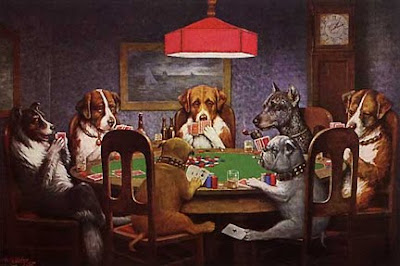
Back in the day, when everybody drank hard liquor, smoked unfiltered, ironed their clothes, and drove classic cars, your dogs might have whiled away the workday hours this way:

But this is Austin and a new era, so while you're working too many hours for too little pay, your dogs are probably improving themselves by doing yoga, learning Spanish online, watching organic gardening shows on the Create channel, or participating in a book club in which they read and discuss the merits of dog-centric books, such as Racing in the Rain ("Meh.") and Marlee and Me ("Enough with the dying dogs! Pass me a kleenex!").

It could happen. Want proof? 


Yes, the masterpiece of doggie kitsch has been lovingly reinterpreted by an artist named Mark Sowa. You can read the story behind the artwork and its source at the always interesting Dog Art Today. 

Now you know why you keep finding spent herbal tea bags and Kashi bar wrappers in the trash when you come home. Also, those mysterious charges on your credit card to Half Price Books.
Ta.
-z

Wednesday, August 19, 2009

Sing Me a Song of Dog Park

Those of you who were fans of the TV series Buffy the Vampire Slayer will remember the character of Angel, who once noted that, as a centuries-old vampire, there were three things he never, ever would do—sunbathe, date, or sing in public. As a decades-old divorcee, I am totally behind Angel on these points, but my dogs will tell you that I have no problem singing to them in the privacy of our home. 

Perhaps because I've been listening to old jazz standards, I've added to our roster of songs, all of which are about the dogs. There are, of course, the songs that are simply the dogs' names sung to the tunes of pop songs from the 60s. One of our perennial favorites is a reworking of "Phenomenon," which I and many of my peers first heard sung by Muppets on Sesame Street. You can guess how it goes: "ARomadog—babeedabeedoo. ARomadog—babeedeedeet." But we also make up songs on the spur of the moment. The latest is one I sing in a plaintive wail to Muzzy when she gets too up-close-and-personal at the dinner table. It kind of sounds like the beginning of "My Darling Clementine," and it goes like this:

Don't put your nose on my glass, please.
Oh, don't put your nose on my glass.
I don't want your nose on my glass, dear,
So don't put your nose on my glass. 

Listening to a CD of Anita O'Day singing  "Sweet Georgia Brown" and "Tea for Two" (in quarter time) has inspired a new set of tunes. There's one that goes "Roma baby, she likes to [fill in the blank.]" I like to fill in the blank with the obvious verbs—eat, poop, beg, sleep, fart, pee, chew, lick her woo—partly because some are naughty, but mostly because they are easily rhymed. My favorite part is the instrumental interlude during which I imagine a trio of Brylcreemed male doot-doot singers crooning while I do a little soft shoe routine (best done in socks on the kitchen tiles), followed by the big finish: "Romadog!" 

The dogs, as you can imagine, are unmoved by my musical tributes. They know that there's no one waiting behind the curtain with a big hook to pull me off the stage, so they just wait through all the bad acts until their favorite shows up—Dog Park. 
-z

Tuesday, July 7, 2009

Doctor Dog

Glancing through the New York Times online this morning, I found an interesting little article by science writer Tara Pope Parker about studies that have shown that some dogs can not only predict cancer, but they can also be responsive to their diabetic owners' drops in blood sugar. Here's how the dogs let their owners know something was wrong: 

Among the dog owners, 138, or 65 percent, said their dog had shown a behavioral reaction to at least one of their hypoglycemic episodes. About a third of the animals had reacted to 11 or more events, with 31.9 percent of animals reacting to 11 or more events. The dogs got their owners’ attention by barking and whining, (61.5 percent), licking (49.2 percent), nuzzling (40.6 percent), jumping on top of them (30.4 percent), and/or staring intently at their faces (41.3 percent). A small percentage of the dogs reportedly tremble in fear at the time of a hypoglycemic attack.

Clearly my dogs are not qualified diagnosticians. Muzzy licks, nuzzles, and stares intently at my face all day long. Am I dying? Meanwhile, Roma finds me interesting only when I am carrying a bowl of food or the car keys. Clearly, I'm fine. Hope you are too.
-z

Saturday, July 4, 2009

Dog Tales


My friend Dave—my best friend's husband and a regular reader of this blog—is one of those rare creatures, a native Austinite. He loaned me a book called Dog Tales by Walter E. Long, "the same author of Dogs Who Have Owned Us." His name will be familiar to Austinites who have boated or swum in Decker Lake, which is east of the city and renamed for Long a while back. Long self-published the book in 1968. Dave's copy is autographed and dated August 3, 1970. All proceeds from the book's sale were donated to a unidentified dog shelter. 

Mr. Long is a writer of modest gifts who gives no information about himself. He calls himself "The Compiler." His focus is the stories of the 15 dogs that "owned him" from the 1930s to the late 1950s. They include Tim, Sally, Sambo, Jingle, Furlough, Puddles, Missie, Rusty, Measles, Hank, Punkin, Ben, and three sheepdogs named Sister. 


Here's how the book begins: 

"There is something about a dog--oh well, you know what I mean, unless you don't like dogs. It does not matter with me whether they are wet or dry, clean or bathed, big or little. When a dog looks at me with an appraising eye, and wags his tail, he is my friend. I'll give him my shirt. I'd do the same for some of my acquaintances if they could wag theirs. 
He is not a hypocrite or double dealer. When you have won his wagging tail or doggy smile--by ears--he's your friend. The value of his love is measured in devotion not in gold."

Introduction to Dog Tales 
Photo is of "the little orphan . . . in his cage"


Long with Sister One

It is clear that Mr. Long is a friend of dogs, but what is also obvious is that he lived in an Austin that is almost unrecognizable today. Attitudes towards dogs—their roles in the family and their care and containment—seem careless and irresponsible compared to how Parkers treat their animals. But in Long's world, vaccines for parvo, distemper, and rabies as well as medications for heart worm and treatment for cancer, which we take for granted now, were not available, and dogs often became fatally sick overnight. Dogs ran free in the city but also in the way of oncoming cars. Long writes lovingly of each dog that entered his life, but most of the narratives end with the dog's sudden, untimely, and often painful death: 

"On a snowy day in February Tim amused himself by playing with a sack on which a stray dog with distemper had lain. Tim contracted the disease and we lost him."

"After two years [Sambo's] fate was sealed by distemper and although Sis [Long's daughter] sat up with him many nights he finally succumbed." (Long, in an attempt to save his dog's life, paid another owner $6.00 in order to draw blood from the dog for a transfusion for Sambo. The procedure did not help.)

One dog is allowed to regularly raid trash cans and ultimately "his failure to eat regularly, his return to trash-canning, and intermittent nights out resulted in his contracting some disease from which he never recovered and he went to dog heaven." Two other dogs die of "undetermined internal trouble."  Another contracts "a peculiar disease from the urine of squirrels or rats for which there seems to be no cure." The dog died "in three days time."  One dog dies from cancer. Another is crushed by a car. 

Long himself was vulnerable to dog-related illness. At one point a neighbor's dog bites him, and he needs nine stitches. He writes "Rabies have not yet set in." 


Measles 

Some of Long's dogs, though, do live long and happy lives. Sally lives to be old (nine years) and fat (though heart worm finally does her in). Sheepdog Ben serves as a local stand-in for the actor-dog in Disney's Shaggy Dog film. Ben gets mobbed by hundreds of fans at the Paramount Theater on Congress Avenue and signs hundreds of "autographs" like this one. 

Ben's fate, and his sister Julie's, are not described in the book. So they must have been alive and well in 1968. Let's hope they had happier endings than many of their predecessors did.

Here's how the book concludes:

"TO YOU WHO LOVE THEM
You may have kicked or ruthlessly scolded him, by he forgave your acts and licked your hand before you realized your crudeness.
From his humble pallet in kennel or basement he keeps an eye open for your protection, or an ear cocked for impending danger to your possessions. 
[. . .]
He humbly takes his place in society, and too often, without appreciation, unostentatiously gives his live for those he owns."

Does this describe any of the dogs we know? 

Many thanks to Dave for lending me Long's fascinating book. 
-z